What Is Yoga? A Deeper Look at Its Meaning, Practice & Purpose
From Ashtanga Yoga and asana to pranayama, meditation and mindful living — understand the classical idea of yoga in simple language. Yoga is not simply a workout. It is a traditional discipline concerned with the relationship between the body, breath, attention and inner awareness.
What Does Yoga Really Mean?
Yoga is often presented as a collection of postures, but the classical tradition gives it a much wider meaning. It is a disciplined way of working with the body, breath, attention and inner life.
The Sanskrit word yoga is associated with the root yuj, commonly understood in the sense of joining, connecting or bringing into disciplined focus. Different yoga traditions explain that idea in different ways, but a common thread is integration rather than exercise alone.
Patanjali’s Yoga Sutra 1.2 gives the well-known definition: “Yogash chitta-vritti-nirodhah.” In simple terms, it points toward quieting the changing activity of the mind. The Bhagavad Gita also presents yoga through ideas such as equanimity and skillful action.
Seen this way, yoga can begin with movement but does not have to end there. Its deeper direction is toward steadiness, awareness and a more conscious way of living.
The Eight Limbs of Ashtanga Yoga
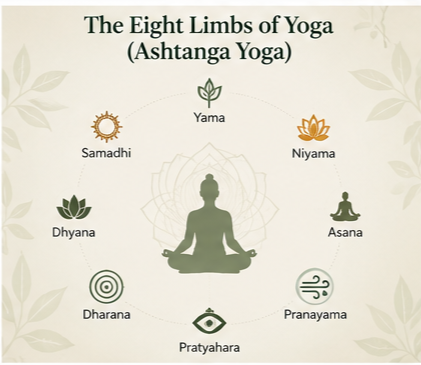
Patanjali describes an eight-part path that gradually moves attention from ethical living and personal discipline toward concentration and meditation. These eight limbs are traditionally called Ashtanga Yoga.
- Yama — principles for how we relate to others, including ahimsa, satya, asteya, brahmacharya and aparigraha.
- Niyama — personal observances such as shaucha, santosha, tapas, svadhyaya and ishvara-pranidhana.
- Asana — cultivating a stable and comfortable posture. Patanjali expresses this concisely as “Sthira-sukham-asanam.”
- Pranayama — working consciously with the breath.
- Pratyahara — turning the senses away from constant external stimulation.
- Dharana — training attention to remain with a chosen point or object.
- Dhyana — allowing concentration to develop into a continuous flow of attention.
- Samadhi — the deepest stage described in this eight-limbed framework, associated with profound absorption and insight.
The important point is that asana is one part of a much larger path. The framework connects conduct, self-discipline, body, breath and mind rather than treating them as unrelated practices.
Asana : More than Flexibility
Hatha Yoga gives importance to physical postures as a foundation for stability and deeper practice. Traditional asanas such as Siddhasana, Paschimottanasana, Mayurasana, Sirsasana, and Shavasana serve different purposes and require varying levels of preparation. Advanced poses should be practiced with proper guidance, while Shavasana helps the body and mind relax.
Understanding Pranayama
Pranayama brings mindful awareness to breathing through puraka (inhalation), kumbhaka (retention), and rechaka (exhalation). Beginners should start with gentle, comfortable breathing rather than forcing the breath or retention. Regular practice can support relaxation, focus, and breath awareness. Intense pranayama and prolonged retention should be learned under qualified guidance.
Meditation and Nadanusandhana
What Is the Deeper Purpose of Yoga?
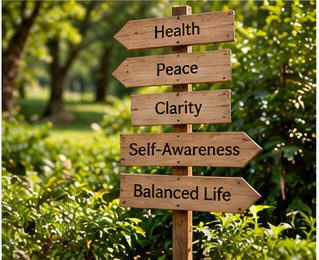
Physical strength, mobility and relaxation can be valuable outcomes of yoga, but classical yoga philosophy points beyond physical performance.
The path is concerned with understanding the mind, reducing unnecessary attachment and aversion, cultivating clarity and moving toward self-knowledge. In the classical framework, kaivalya represents liberation and stands among the highest aims.
Progress can therefore be understood as a gradual shift: from simply noticing the body, to becoming more sensitive to the breath, to observing the mind, and eventually to a deeper recognition of awareness itself.
That perspective changes the question from “How difficult is my posture?” to “How consciously am I living?”
Yoga at Sarvang Yog Arogya
At Sarvang Yog Arogya, the approach to yoga reflects a holistic view of wellness: movement, breath, meditation and lifestyle are treated as connected parts of a person's well-being.
The centre's current programs include yoga classes, meditation, sound healing, yoga teacher training and other wellness-oriented offerings. Its website describes the broader aim as bringing together body, mind and inner balance through structured practice.
For someone beginning a yoga journey, the most useful approach is usually consistent, appropriately guided practice rather than chasing quick results. Yoga can become a practical discipline for developing greater awareness in everyday life.
Book Demo SessionConclusion: Let Yoga Become a Way of Living
Yoga is much larger than a sequence of physical poses. Its classical vision brings together ethical living, disciplined practice, posture, breath, concentration and meditation. The journey may start with the body, but it can gradually become an exploration of attention, mental habits and self-awareness. That is why yoga can remain relevant both on the practice mat and in ordinary life.
If you want to explore yoga in a structured and holistic way, Sarvang Yog Arogya offers guided practices and wellness programs in Lucknow.
Begin Your Yoga Journey
Explore guided yoga, meditation and wellness practices with Sarvang Yog Arogya in Lucknow.